


 Cart
Cart
 sales@molnova.com


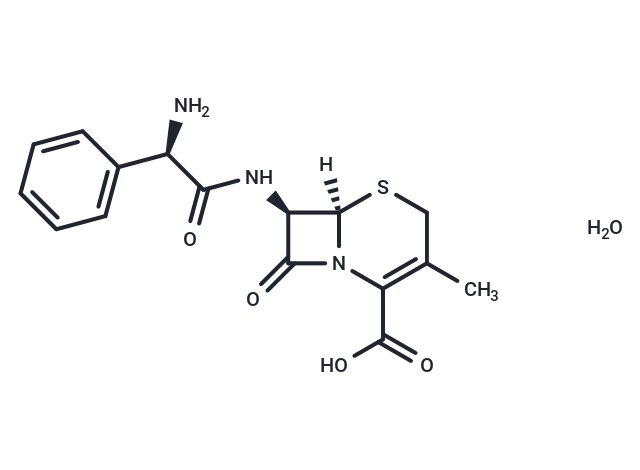
Cephalexin monohydrate
CAS No. 23325-78-2
Cephalexin monohydrate( —— )
Catalog No. M33648 CAS No. 23325-78-2
Cephalexin monohydrate (Cephalexin hydrate) is an orally available semi-synthetic cephalosporin antibiotic with significant antimicrobial activity that inhibits bacterial proliferation by targeting penicillin-binding proteins (PBPs).
Purity : >98% (HPLC)
 COA
Datasheet
HNMR
HPLC
MSDS
Handing Instructions
COA
Datasheet
HNMR
HPLC
MSDS
Handing Instructions
| Size | Price / USD | Stock | Quantity |
| 500MG | 38 | In Stock |


|
| 1G | Get Quote | In Stock |
|
Biological Information
-
Product NameCephalexin monohydrate
-
NoteResearch use only, not for human use.
-
Brief DescriptionCephalexin monohydrate (Cephalexin hydrate) is an orally available semi-synthetic cephalosporin antibiotic with significant antimicrobial activity that inhibits bacterial proliferation by targeting penicillin-binding proteins (PBPs).
-
DescriptionCephalexin (Cefalexin) monohydrate is a potent, orally active new semisynthetic cephalosporin antibiotic with a broad antibacterial spectrum. Cephalexin (Cefalexin) monohydrate has antibacterial activity against a wide variety of gram-positive and gram-negative bacteria. Cephalexin (Cefalexin) monohydrate targets penicillin-binding proteins (PBPs) to inhibit bacterial cell wall assembly. Cephalexin (Cefalexin) monohydrate is used for the research of pneumonia, strep throat, and bacterial endocarditis, et al.
-
In VitroCephalexin (Cefalexin) monohydrate (10 μg/mL) disrupts polymer peptidoglycan (PG) biogenesis by inactivating enzymes called penicillin-binding proteins (PBPs).Cephalexin (Cefalexin) monohydrate inhibits a broad spectrum of grampositive and gram-negative organisms with MIC values of 2, 2, 2, 2, 4, 4.4 and 5.7 μg/mL for Bacillus anthracis, Edwardsiella taFda, Vibrio cholera, Pasteurella multocida, Edwardsiella tarda, Alcaligenes sp and Proteus rettgeri, respectively.
-
In VivoCephalexin (Cefalexin) monohydrate (0-50 mg/kg; p.o.; for 3.5 hours) has antibacterial activity in male Swiss-Webster mice with infected bacterial.Animal Model:Male Swiss-Webster mice with infected bacterial Dosage:0-50 mg/kg Administration:Oral administration; for 3.5 hours Result:Had antibacterial activity against Streptococcus pyogenes, Streptococcus pneumoniae, Staphylococcus aureus and several gram-negative species mice.
-
Synonyms——
-
PathwayMicrobiology/Virology
-
TargetAntibiotic
-
RecptorAntibiotic
-
Research Area——
-
Indication——
Chemical Information
-
CAS Number23325-78-2
-
Formula Weight365.4
-
Molecular FormulaC16H19N3O5S
-
Purity>98% (HPLC)
-
SolubilityIn Vitro:?DMSO : 6.67 mg/mL (18.25 mM; Ultrasonic )H2O : 2 mg/mL (5.47 mM; Ultrasonic)
-
SMILESO=C1N2[C@@]([C@@H]1NC([C@H](N)C3=CC=CC=C3)=O)(SCC(C)=C2C(O)=O)[H].O
-
Chemical Name——
Shipping & Storage Information
-
Storage(-20℃)
-
ShippingWith Ice Pack
-
Stability≥ 2 years
Reference
1. Cho H, et, al. Beta-lactam antibiotics induce a lethal malfunctioning of the bacterial cell wall synthesis machinery. Cell. 2014 Dec 4;159(6):1300-11. ?
molnova catalog



related products
-
5-Bromo-2’,3’,5’-tri...
5-Bromo-2’,3’,5’-tri-O-acetyluridine is a purine nucleoside analog that is being explored to improve Alzheimer’s and Parkinson’s diseases.
-
LNA-Adenosine
LNA-Adenosine (LNA-A) is a nucleoside analogue that acts as a ligand for adenosine A3 receptors.
-
Nosiheptide
Nosiheptide is a thiopeptide antibiotic produced by Streptomyces actuosus.
